
Encountering rock during excavation can change more than the equipment on site. A foundation excavation, utility trench, or basement expansion may suddenly require blasting or hours of hydraulic breaking, with neighboring buildings just beyond the work area.
Before that work begins, the project team needs to know how vibration will be measured, which properties need monitoring, and who responds if readings approach the project’s limits. Waiting until a neighbor reports shaking makes those decisions harder. If no earlier condition survey exists, there may also be no baseline for evaluating a reported crack.
Blasting vibration monitoring uses seismographs to measure and record ground vibration at selected locations near the work. Together with existing conditions documentation and crack gauges at identified areas of concern, it helps your team compare recorded vibration with documented property conditions and investigate reported changes.
Saltus provides vibration monitoring services for projects in New York City and surrounding areas, with both wireless systems and manned technician options. Planning starts with the removal method, nearby buildings, and the information your project team receives.
How Blasting and Mechanical Rock Breaking Differ
Blasting produces a brief event. Hoe ramming and hydraulic breaking produce repeated impacts that may continue through much of a workday. Those differences affect how the work should be recorded and how neighboring occupants experience it.
Blasting
The total amount of explosives used does not, by itself, tell you what vibration will reach a neighboring building. Maximum charge weight per delay and distance to the monitoring location are important inputs.
The Office of Surface Mining Reclamation and Enforcement (OSMRE) uses those factors alongside measured peak particle velocity in its Blast-Induced Vibration Data Evaluation Program. Although that publication addresses surface-mine blasting, it explains why vibration records need to be connected to the corresponding charge and distance information. Its mining criteria should not be assumed to govern an urban excavation project.
For a construction project, keep each monitoring record with the corresponding blast log. That connection helps the team compare events and investigate reported disturbances.
Hoe Ramming and Hydraulic Breaking
Hoe rams, hydraulic breakers, and hydraulic hammers are common names
used for equipment that breaks material through repeated impacts. Equipment energy and distance influence the vibration reaching nearby structures.
Mechanical breaking does not necessarily produce a lower peak reading at a neighboring building than blasting. The comparison depends on the particular equipment or blast, its location, and the ground conditions. A method’s name is not enough to rank its effect on the building.
Duration matters, too. An occupant may tolerate one brief disturbance differently from repeated hammering throughout the afternoon. Monitoring should cover active breaking periods, with equipment locations and operating times recorded so the readings can be connected to the work.
Drilling and Other Excavation Activities
Include percussive drilling, ripping, and material handling in the work description supplied to the monitoring team. Note whether several machines will operate at once.
If the contractor changes from drilling to breaking, introduces a larger hammer, or moves the work closer to a neighboring foundation, review the monitoring coverage before that change. Otherwise, the records may describe the original operation more clearly than the work actually taking place.
Why Distance Alone Is Not Enough
Vibration generally decreases as it travels away from its source, but soil and rock conditions affect that reduction. Building construction and condition also influence the assessment. A distance that worked on one project does not establish an acceptable setback on another.
Provide the monitoring team with the excavation limits, anticipated depths, available geotechnical information, and neighboring building locations. Call out concerns such as an older masonry wall, an existing foundation crack, or sensitive equipment in an adjoining facility.
The layout may need to change as excavation progresses. An instrument placed for work at one end of the site may not adequately represent exposure at a building beside the next phase.
Document Conditions Before Rock Removal Begins
A crack reported during excavation raises an immediate question: was it there before the work started?
Existing Conditions Documentation establishes a photographic record of accessible neighboring properties. Saltus documents visible issues before construction and performs follow-up inspections and photography afterward. The initial inspection also helps identify locations for vibration sensors and crack gauges.
Arrange access early enough to complete the agreed survey before blasting or breaking begins. Photographs should show both the overall area and individual conditions, with location descriptions that allow someone to find the same crack or surface again. Record inaccessible rooms, concealed areas, and other limitations.
If rock is encountered unexpectedly after excavation has started, document current conditions before introducing the new removal method. Be precise about the timing: that survey establishes conditions before rock removal, not necessarily before all construction.
Where traffic, transit, or other nearby activity may complicate interpretation, discuss background vibration measurements before the high-energy work starts. Photographs show what was visible; background measurements help characterize vibration already present.
Choose Monitoring Locations Around the Buildings at Risk
Seismographs need locations that produce useful measurements for the structures being evaluated.
The International Society of Explosives Engineers (ISEE) addresses placement in its Field Practice Guidelines for Blasting Seismographs. For ground-vibration monitoring, the guidance generally calls for positioning the sensor on or in the ground on the side of the structure toward the blast. Firm contact between the sensor and the monitored surface, known as coupling, is essential.
The guidelines also allow attachment to a structure’s foundation when site constraints, regulations, or project specifications call for measuring the structure’s response to ground motion. Your monitoring plan should make clear which measurement is intended.
Discuss access to neighboring properties with Saltus early, so monitoring locations can be arranged before work begins. If a preferred location is unavailable, discuss what an alternative location can measure and any limitations it introduces. Separate buildings or sensitive areas may need separate monitoring points.
For blasting, also establish whether air-overpressure monitoring belongs in the scope. Airblast travels through the air and is measured with an appropriate microphone. A ground-vibration sensor alone does not measure it.
Choosing Between Wireless and Manned Monitoring
Saltus’s wireless vibration monitoring records vibration and sends automatic notifications when predetermined thresholds are exceeded. Manned monitoring places a technician on site to review readings and communicate directly with site managers and engineers.
When discussing the choice with Saltus, consider how the work will run:
- For ongoing work at established monitoring locations, ask whether wireless monitoring can provide the required coverage and notifications.
- For work requiring immediate coordination with the crew, discuss an on-site technician, particularly during closely controlled activities near sensitive structures.
- For projects with distinct phases, ask whether a combination would suit the schedule.
Where specifications require attendance, build that requirement into the scope from the start.
Wireless monitoring still needs a response arrangement. Someone must receive the alert, assess it, and communicate with the person authorized to direct the work.
Saltus has used both approaches on the same project. At 321–325 West 35th Street in Manhattan, we provided monitoring during a 16-month foundation project. Preconstruction inspections identified cracks in surrounding buildings, leading to the installation of crack gauges alongside seismographs and the use of wireless and manned vibration monitoring. This foundation project illustrates how the services can work together around existing buildings.
Set Thresholds and Decide Who Responds
Peak particle velocity, or PPV, is the maximum speed of particle motion during vibration. It is commonly reported in inches per second or millimeters per second. It does not describe how far a building moved.
The responsible project professionals should establish criteria for the structures, activities, and requirements involved. Some criteria also depend on vibration frequency. Sensitive equipment may need an assessment beyond the criteria used for building damage.
Your monitoring plan should distinguish between recording an event, sending a warning, and requiring action:
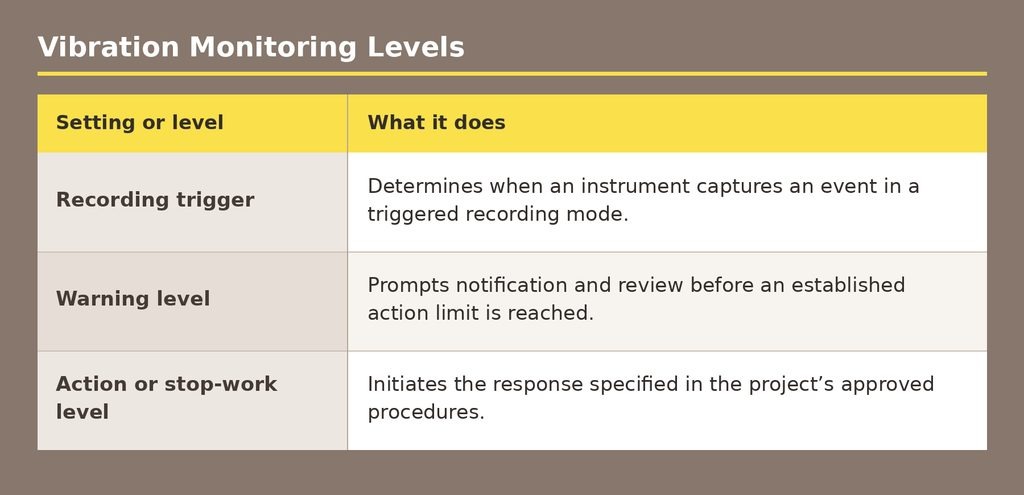
A recording trigger is not a damage limit. The ISEE recommends setting triggers low enough, where practical, to capture each blast and retaining the full waveform rather than only a peak reading.
As you plan monitoring with Saltus, clarify who on your team will receive alerts, who will review the readings, and who has authority to pause the work. Agreeing on those responsibilities and the conditions for restarting helps your team respond promptly when a threshold is reached.
For blasting, an alert informs the response to the recorded event and subsequent work. It cannot interrupt a detonation already underway.
Use Crack Gauges Where Changes Need to Be Tracked
A seismograph records vibration at its sensor. A crack gauge tracks movement across a particular crack.
If the initial survey identifies a crack that needs observation, Crack Gauge Monitoring creates a measurement history through the work. Saltus offers wireless gauges with automated readings and stationary gauges read by technicians during site visits.
Take initial readings before the relevant activity begins and agree on the reading schedule. Later measurements can then be compared with construction dates and vibration events.
A gauge does not establish why a crack changed, and one unchanged crack does not describe the entire building. If movement is detected, the project team needs to assess the condition, timing, and other evidence before drawing conclusions.
Handle Neighbor Complaints With Details, Not Assurances
People can feel vibration below levels used to assess building-damage potential, a distinction addressed in OSMRE’s blasting guidance. A neighbor’s report of shaking deserves a clear response, even when readings remain below the project’s limits.
Give owners and occupants a clear contact for concerns. Record the time, location, and description of each reported disturbance. “The bedroom windows rattled at 10:15” is much easier to investigate than “the building shook this morning.”
Compare the report with the work log and monitoring records. If damage is reported, check the baseline photographs and arrange an appropriate follow-up inspection.
Explain what was measured and where. A reading below the project threshold is useful evidence, but it is not a substitute for inspecting a reported condition.
Agree on Reports and Keep the Supporting Records
Saltus’s wireless systems automatically send reports to clients, while manned monitoring provides on-site data review and direct communication.
Before mobilization, ask Saltus to identify the deliverables in your proposed scope. Agree on report frequency and format, notification recipients, data-review responsibilities, and any submission requirements from the engineer, owner, or agency. An automated notification and a reviewed report serve different purposes.
For a record that can be evaluated after the work, retain:
- Blast logs or equipment records showing locations and operating times.
- Instrument identification, calibration records, and monitoring locations.
- Original event data and the criteria used to assess it.
- Alerts, documented responses, and changes to the work.
- Baseline photographs, crack gauge readings, and complaint follow-up.
The ISEE recommends documenting the exact monitoring location, distance to the blast and field setup, as well as retaining full blast waveforms.
Your records should identify monitoring interruptions so anyone reviewing the results can see where coverage was incomplete. That distinction matters when investigating a complaint: a period with no recorded event is different from a period when monitoring was unavailable.
Plan Your Rock Excavation Monitoring With Saltus
If your project involves blasting, hoe ramming, or hydraulic breaking near existing buildings, contact Saltus before that work begins.
Send us your site plan, anticipated removal method, charge or equipment information, neighboring structure details, and project specifications. Include the schedule, reporting requirements, and known access restrictions.
We can recommend a scope for construction vibration monitoring for blasting and mechanical rock removal, with existing conditions documentation and crack gauge monitoring based on the conditions around your excavation.
Contact Saltus to discuss monitoring locations, notifications, and reporting for your project.